By Ravanbakhsh Yuzkhan
The Tones of East Turkistan: Uyghur Music and the Politics of Identity in the People’s Republic of China
Islam is often popularly imagined as hostile to music, and this view is not without precedent: the founders of all four major Sunni legal schools are recorded as holding negative views of it.[1] Yet this was never a settled consensus. Scholars such as al-Ghazali argued that music could itself be an act of worship, and across much of the Islamic world music and its practitioners have flourished. Nowhere is this truer than among the Uyghurs of modern Xinjiang, whose old proverb holds that “God goes with the Prophet, song goes with dance” (Khuda bilen Resul, nakhsha bilen usul). For the Uyghurs, music and dance have historically been sacred, and Islam and culture are not analytically separable. Uyghur music is the clearest evidence of that fusion.
It is also, today, one of the more difficult subjects an anthropologist can study. Since 2014 the Chinese government has pursued a systematic policy of ethnic and religious erasure against the Uyghurs, and many of the musicians, scholars, and religious figures who would otherwise be primary sources for this kind of research have been detained.[2] This paper asks two questions: what constitutes Uyghur music, and what has happened to it under the current policies of the Chinese state.
Who are the Uyghurs? The Uyghurs are a Turkic people of Xinjiang, a region they often call “East Turkestan,” geographically and culturally part of Central Asia despite its political incorporation into China. Uyghur ethnogenesis began with the arrival of Turkic conquerors from Mongolia and Kazakhstan into a Xinjiang then dominated by Iranic peoples; the resulting mixed population, ruled successively by the Göktürk and Uyghur Khaganates, came to speak Turkic languages and follow Turkic custom.[3] Central Asian culture, and especially its music, was prized in China itself: musicians from the region joined the retinues of Tang emperors, and instruments such as the Chinese pipa likely descend from Central Asian lutes like the barbat.[4]
The decisive turn came with the Karakhanid dynasty. Its ruler Satuq Bughra Khan adopted Hanafi Sunni Islam before ascending the throne in 942, becoming one of the first Turkic rulers to do so, and spread the faith through his realm. Under the Karakhanids and, later, the Chagatai Khanate (founded by a son of Genghis Khan but soon assimilated into local Turkic-Islamic culture), the proto-Uyghur population adopted Sufism, and Sufi orders wove music into religious practice as a vehicle for divine knowledge. Scholars generally treat the Karakhanids as the direct cultural ancestors of today’s Uyghurs.[5]
Qing conquest in the eighteenth century broke this pattern of patronage. Qing administration was extractive rather than integrative, and Uyghur identity hardened in opposition to it. When the Qing collapsed, Turkic intellectuals of Xinjiang revived the medieval ethnonym “Uyghur” for themselves, asserting continuity with the old Khaganate and identifying more with fellow Turkic Muslims of the Soviet Union than with a Chinese state now built around Han identity. Two short-lived Uyghur republics followed, one explicitly Islamic and anti-Soviet, the other a Soviet-aligned satellite; both fell to Kuomintang forces, and Xinjiang passed in turn to the People’s Republic of China.[6]
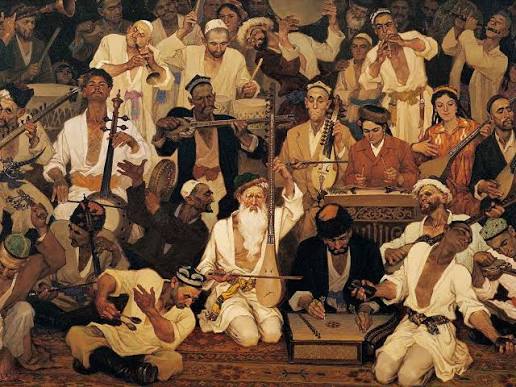
Musical Form and Practice. Uyghur music is built on a distinctive instrumentarium and a distinctive theory of mode. The dutar, a two-stringed lute common across Turkic and Iranic Central Asia, is the most widely played instrument; the rawap, a long-necked lute traditionally skinned with snake, fish, or livestock hide, typically carries the melodic lead. The ghijak (spiked fiddle), dap (frame drum), sattar (bowed lute), and sunay (reed instrument) round out the traditional ensemble. In the past half-century younger musicians have absorbed outside influences as well, most notably the guitar; the global popularity of flamenco groups such as the Gypsy Kings produced a distinctively Uyghur style of guitar playing that layers Central Asian melody and rhythm over flamenco technique.[7]
Theoretically, Uyghur music is organized around the Twelve Muqams (On Ikki Muqamlar), a modal system related to but far more restrictive than comparable systems among neighboring Turkic peoples — Turkish classical music, for instance, recognizes over forty makams. Nearly the entire canon of Uyghur music is built from these twelve modes, though folk musicians outside the formal tradition sometimes work independently of the system entirely. Uyghur folk memory credits its codification to Āmānnisā Khan, consort of the Chagatai ruler Abdurashid Khan, as the figure who compiled and preserved the tradition and fixed it as the standard of Uyghur music.[8] [9]
The system is inseparable from religion. Uyghur musicians are traditionally trained through religious repertoire, and the most accomplished among them are typically disciples of Sufi orders for whom music is itself worship. Meshrep, the traditional communal gathering of song and dance organized by village elders (aqsaqalar), grew directly out of Sufi ritual; its poetry is drawn from Sufi masters such as Ahmad Yasawi, and it belongs to the same family of practice as sema gatherings found from Turkey to Pakistan. What looks, from the outside, like a folk festival is in substance an Islamic rite.[10]
Music Under Repression. Since 2014 the Chinese state has pursued the systematic internment of Uyghurs in re-education camps, where survivors and leaked government documents describe forced labor, sexual abuse, and the coerced abandonment of religious practice, sometimes triggered by signs as minor as growing a beard or declining to smoke.[11] Uyghur intellectuals, writers, and musicians have been disproportionately targeted, since Islamic and cultural expression is treated by the state as inseparable from separatism. Outside the camps, the same logic operates on the built environment: mosques, Sufi shrines, and sites associated with Uyghur Islamic scholarship, including tombs linked to figures such as Mahmud of Kashgar, have been demolished.[12]
Meshrep offers the clearest case study of what this repression does to Uyghur music specifically. In its traditional form, meshrep is organized locally, sponsored by Sufi leaders, and built around explicitly religious repertoire. The state-sponsored version now staged for tourists in Xinjiang strips that content out entirely: the poetry of Sufi masters has been replaced with secular popular song, and Uyghur artists have been directed to rework Chinese popular music with Uyghur lyrics and instrumentation.[13] The result is Uyghur music emptied of the religious and communal meaning that historically defined it — a performance of Uyghur culture staged for a Han audience rather than a living practice belonging to Uyghurs themselves.
The state has also moved directly against musicians who declined to participate in that substitution. Abdurehim Heyit, one of the most prominent Uyghur musicians of his generation and a master of religious meshrep repertoire, was detained in 2019 shortly after performing a piece describing Xinjiang as land the Uyghurs had “bled for.” He disappeared from public view for years; when Chinese authorities eventually released a video to counter international outcry, observers noted his shaved mustache and altered manner as signs of coercion, and he has not returned to public life since. Rashida Dawut, another musician who worked in traditional idioms outside state programming, has faced similar treatment.[14] [15]
Even the music the state does permit is structured around Han primacy: Uyghur performances in Xinjiang are staged for Chinese tourists rather than Uyghur audiences, Uyghur students are steered toward Chinese opera over Uyghur repertoire, and where Uyghur music is broadcast at all, it typically appears as a supporting act to Han programming.[16]
Conclusion. Uyghur music is, in its own homeland, no longer permitted to exist on its own terms; its religious content has been excised and its performance repurposed as a display of successful assimilation for outside consumption. What survives intact survives in the diaspora, where Uyghur musicians continue to play, teach, and record the Twelve Muqams and the repertoire of meshrep outside the reach of the state that has worked to dismantle them at home. For an anthropologist, that displacement is itself the finding: a tradition inseparable from a people’s faith can be studied honestly only where that faith is still permitted to be lived.
[1]Ian Bedford, “The Interdiction of Music in Islam,” The Australian Journal of Anthropology 12, no. 1 (2001): 1–14.
[2]Amy Anderson and Darren Byler, “‘Eating Hanness’: Uyghur Musical Tradition in a Time of Re-Education,” China Perspectives, no. 3 (118) (2019): 17–26.
[3]James A. Millward, “Ancient Encounters (Earliest Times–8th Century),” in Eurasian Crossroads: A History of Xinjiang, Revised and Updated (Columbia University Press, 2021), 1–38.
[4]World Uyghur Congress, “Uyghur Music,” accessed May 2, 2024.
[5]James A. Millward, “Between Islam and China (16th–19th Centuries),” in Eurasian Crossroads, 77–122.
[6]James A. Millward, “Between China and the Soviet Union (1910s–1940s),” in Eurasian Crossroads, 175–230.
[7]World Uyghur Congress, “Uyghur Music,” accessed May 2, 2024.
[8]Rachel Harris, Soundscapes of Uyghur Islam (Bloomington: Indiana University Press, 2020).
[9]Elise Anderson, “The Construction of Āmānnisā Khan as a Uyghur Musical Culture Hero,” Asian Music 43, no. 1 (2012): 64–90.
[10]Rachel Harris, Soundscapes of Uyghur Islam (Bloomington: Indiana University Press, 2020).
[11]Office of the United Nations High Commissioner for Human Rights, “OHCHR Assessment of Human Rights Concerns in Xinjiang Uyghur Autonomous Region.”
[12]Radio Free Europe/Radio Liberty, “China’s Ancient Silk Road City of Kashgar Facing Chinese Bulldozers.”
[13]Amy Anderson and Darren Byler, “‘Eating Hanness’: Uyghur Musical Tradition in a Time of Re-Education,” China Perspectives, no. 3 (118) (2019): 17–26.
[14]BBC News, “China Muslims: Xinjiang Schools Used to Separate Children from Families,” accessed May 3, 2024.
[15]PEN America, “Prison Sentence for Uyghur Singer Part of China’s Efforts to Eradicate Uyghur Culture,” accessed May 3, 2024.
[16]Amy Anderson and Darren Byler, “‘Eating Hanness’: Uyghur Musical Tradition in a Time of Re-Education,” China Perspectives, no. 3 (118) (2019): 17–26.
 Loading…

 Reload document
  Open in new tab
Leave a Reply